As I stated before, this is just a BAD idea. I would abandon it and look for something else to with lasers. After seeing a photo of what you are going for, all I can say is Yikes! You will end up blind and likely blind someone else who will have all your possessions and then have you thrown in jail.
Exactly paul--bad idea plus the guy has no idea of what he is doing from the questions asked. Is not as simple as in imagination where everything is possible, simple, and no problem.
Hi everyone,
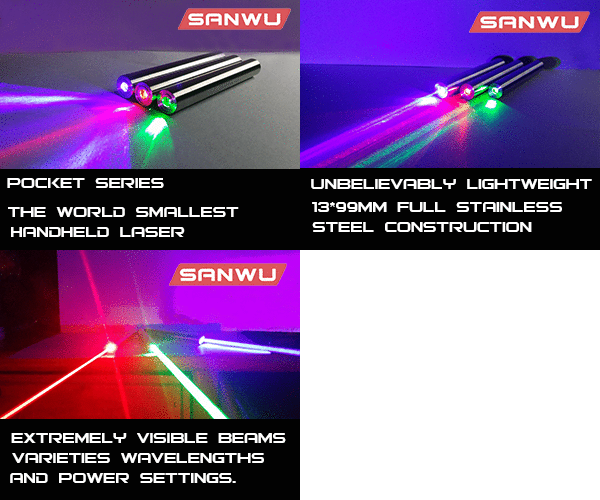
I am trying to make a laser costume with the basic idea like in this photo.
You have not indicated you purpose other costume--for what who knows but it seems to be an imagined/imaginary device you want to make for frivolous entertainment, attention seeking purposes.
PS the laser in your photo are not direct diode laser they are 532nm DPSS green lasers. THere is not any "diode" that does that wavelength ---expensive around a couple of hundred dollars each small DPSS 532nm lasers are available see:
http://www.snakecreeklasers.com/products/laserheads.aspx
Regardless, it is not a very sound or good idea and could only be used without risk to yourself or others under specific controlled conditions/circumstances.
Aside from being difficult to see without fog and being expensive to do even if possible-- since you know nothing about lasers and have no idea or what you are doing/want to do it is a bad idea - what you want to make is something with 20 of them --20X the hazards and with no real control of where they are pointing and begging for trouble.
You would be much better off safety wise and it would be a lot cheaper to use LEDs to make and attention attracting piece of clothing.
Here is a good eye hazard chart that shows graphically laser hazards --
http://www.lasersafetyfacts.com/resources/FAA---visible-laser-hazard-calcs-for-LSF-v02.png
The truth of the matter is a 5mW laser can cause eye damage and even a 1mW or less laser can also cause eye damage see following information:
5mW or less--EYE INJURY HAZARD -- DIRECT AND REFLECTED BEAM
Class 3R visible-light lasers are considered safe for unintentional eye exposure, because a person will normally turn away or blink to avoid the bright light. Do NOT deliberately look into or stare into the beam -- this can cause injury to the retina in the back of the eye.
Be aware of beam reflections off glass and shiny surfaces. Depending on the surface, the reflected beam could be about as strong and as focused as a direct beam.
The Nominal Ocular Hazard Distance (NOHD) for the most powerful Class 3R visible-beam laser (4.99 mW) with a tight beam (0.5 milliradian divergence) is 104 ft (32 m).
For a 4.99 mW Class 3R laser with a less-tight beam that spreads out faster (1 milliradian), the NOHD is 52 feet (16 m). This divergence is more typical of consumer lasers.
If you are closer than the NOHD distance to the laser, there is a possibility of retinal damage if the direct or reflected beam enters your eye longer than about ¼ second. The closer you are to the laser and the longer the beam is in the eye, the greater the chance of injury. see:
Safety of Class 3R visible-beam lasers
Even 1mW or less can cause eye damage --<1mW EYE INJURY HAZARD -- DIRECT AND REFLECTED BEAM
Class 2 visible-light lasers are considered safe for unintentional eye exposure, because a person will normally turn away or blink to avoid the bright light. Do NOT deliberately stare into the beam -- this can cause injury to the retina in the back of the eye.
Be aware of beam reflections off glass and shiny surfaces. Depending on the surface, the reflected beam could be about as strong and as focused as a direct beam.
The Nominal Ocular Hazard Distance (NOHD) for the most powerful Class 2 laser (0.99 mW) with a tight beam (0.5 milliradian divergence) is 46 ft (14 m).
For a 0.99 mW Class 2 laser with a less-tight beam that spreads out faster (1 milliradian), the NOHD is 23 feet (7 m). This divergence is more typical of consumer lasers.
If you are closer than the NOHD distance to the laser, there is a possibility of retinal damage if the direct or reflected beam enters your eye for longer than about ¼ second. The closer you are to the laser and the longer the beam is in the eye, the greater the chance of injury. see:
Safety of Class 2 visible-beam lasers
You do not indicate what wavelength or "color" laser you want to use but the photo indicate green--there are a lot of technical problems and complications even if you can come up with 20 green lasers less the 5mW and even if less than 1mW ---like powering them and effectively mounting them and switching them, buying diodes and and all the other parts needed + assembling 20 complete lasers for your purpose.
Not cheap, time consuming, expensive, not to mention all the LEGAL use complication as Hak mentioned unless you want to use it alone in your room. :crackup:
LEDs are a different story and not eye hazards ---LEDs are a much better idea--still not a simple thing to accomplish.






 op:
op:
